

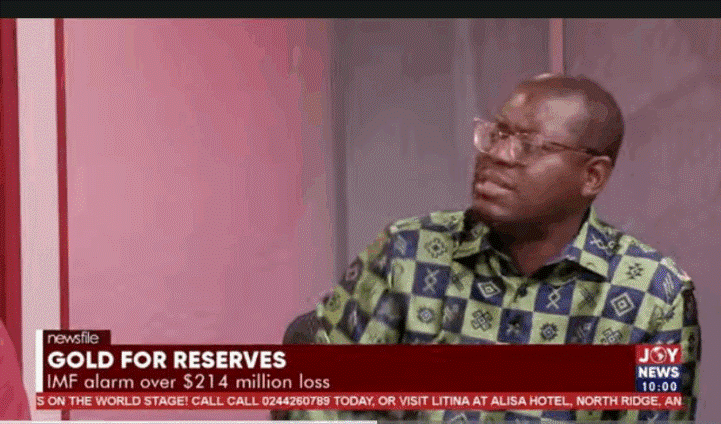
Bright Simons, Honorary Vice President of IMANI-Africa, has called for tougher oversight of how government institutions spend money, saying that even agencies set up to promote national development must still meet high standards of efficiency and sustainability.
Speaking on JoyNews’ Newsfile on Saturday, January 3, Mr. Simons said discussions around GoldBod, the Bank of Ghana and gold market interventions highlight a much bigger issue in the country — that many public institutions are not being properly assessed for how well they use resources.
“There are many policy institutions in this country where we assume they are efficient simply because they are not meant to make profits. That assumption is dangerous,” he warned.
To make his point, Mr. Simons referred to the Ghana Cocoa Board (COCOBOD), a state agency created to support cocoa farmers, grow the cocoa industry and earn foreign exchange, not to make profits.
“COCOBOD is not a limited liability company, but we still monitor its losses closely, and rightly so, because of how they affect the sector,” he said.
He noted that COCOBOD leaders over the years have often complained about how losses put pressure on the cocoa industry, adding that his own analysis shows COCOBOD’s losses in the past four years are far lower than the losses being discussed in some other policy programmes.
According to him, if the country is willing to closely examine how COCOBOD uses public funds, the same level of scrutiny should apply to all policy-driven institutions, including those operating in the gold market.
“The logic is simple,” he said. “If we demand efficiency from one institution, we cannot turn a blind eye to inefficiency in another.”
Mr. Simons also used fuel pricing and subsidies to explain the wider impact of government policy. He pointed out that fuel prices affect everything from inflation and business costs to household spending.
“Fuel affects every part of the economy. That’s why governments subsidised it for many years — to protect businesses and ordinary people,” he explained.
However, he cautioned that when such subsidies become too expensive to sustain, governments are forced to step in with measures like taxes to cover the rising costs.
“Just because a policy is well-intentioned doesn’t mean we should ignore inefficiency. At some point, the cost has to be paid,” he said.
He urged policymakers to strike a balance between development goals and responsible financial management, warning that failing to do so could threaten Ghana’s long-term economic stability.

